
CGC 10 Pokemon Cards Sell for About Half a PSA 10
We read every recorded eBay sale of six graded Pokemon chase cards. A CGC Gem Mint 10 sold 23 to 55% under the PSA 10 of the same card, every time.
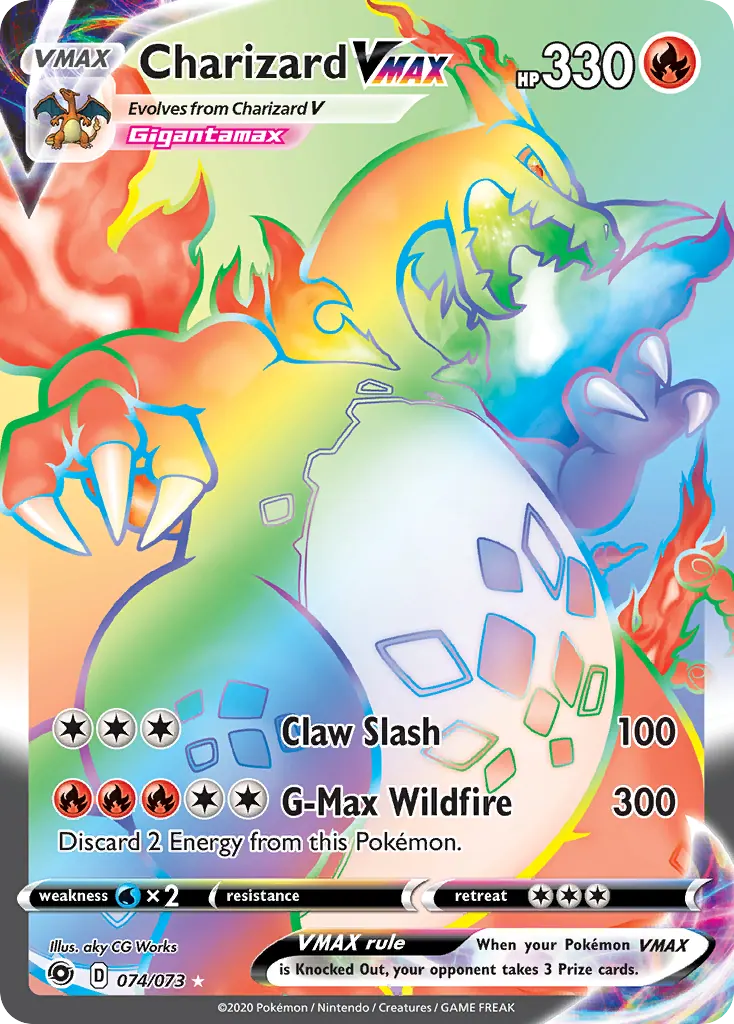
On November 9 somebody paid $223.94 for a CGC Gem Mint 10 Charizard ex from Obsidian Flames. The same day, on the same site, a PSA 10 of that exact card sold for $659.99. Both labels say 10 on the front, and both companies print the same centering rule for that grade.
We went looking for how wide that gap really is, because the usual answer in the hobby is a vague "PSA sells for more" with a range attached and no sales behind it. So we pulled the complete record of eBay sales PriceCharting holds on six heavily graded Pokemon chase cards, split every sale by which company's slab it was, and threw out anything that sold before September 1. Every number below is the middle sale in that group, read on November 16, with the number of sales it came from in brackets.
CGC 10 vs PSA 10 on six Pokemon cards
| Card | Raw | PSA 10 | CGC Gem Mint 10 | CGC vs PSA |
|---|---|---|---|---|
| Charizard ex 223, Obsidian Flames | $90.00 (58) | $610.00 (29) | $272.00 (21) | 55% less |
| Pikachu ex 238, Surging Sparks | $230.00 (60) | $690.00 (30) | $329.99 (13) | 52% less |
| Giratina V 186, Lost Origin | $799.99 (53) | $3,050.00 (30) | $1,478.66 (14) | 52% less |
| Umbreon ex 161, Prismatic Evolutions | $1,144.38 (56) | $4,050.00 (29) | $2,099.99 (29) | 48% less |
| Charizard VMAX 74, Champion's Path | $169.95 (59) | $298.69 (25) | $226.50 (10) | 24% less |
| Umbreon VMAX 215, Evolving Skies | $1,950.00 (47) | $3,555.50 (30) | $2,749.00 (13) | 23% less |
All six gaps point the same way, and the middle one is just under half. The two cards at the narrow end are the two oldest ones here, Champion's Path from 2020 and Evolving Skies from 2021, which runs against the usual claim that CGC does worse on older cards. The four modern Scarlet and Violet era cards are where the discount bites hardest.
One warning about reading these numbers anywhere else. PriceCharting keeps roughly the last 30 sales for each grade, so a grade that sells constantly shows you two weeks and a grade that barely sells shows you two years. All thirty PSA 10 sales of the Giratina V happened between October 27 and November 16. If you compare that against a run of CGC sales stretching back to February without noticing, you are comparing this month's market to last winter's. We hit the same problem last week when we read TCGplayer's published market price against the cheapest buyable copy, and the fix is the same: check what dates the numbers came from before you compare them.
CGC and PSA print the same centering rule for a 10
Here is the part that makes the gap strange. PSA's grading standards page says a Gem Mint 10 must be centered "within a tolerance not to exceed approximately 55/45 percent on the front, and 75/25 percent on the reverse." CGC's grading scale page sets its Gem Mint 10 centering at "not to exceed approximately 55/45" with reverse centering "not to exceed 75/25." Those are the same words and the same numbers, read off both companies' own sites on November 16.
Whether two graders apply an identical written rule with identical strictness is a separate question, and we have no verified pass-rate comparison between them, so we are not going to claim one. What we can say is that the price gap is not coming from the published standard, because there is no difference in the published standard to point at. Buyers are paying for the red label.
CGC Pristine 10 and TAG 10 are a different story
CGC has a grade above Gem Mint. A Pristine 10 needs 50/50 centering plus what CGC calls "flawless color and registration," and it is the only CGC label that regularly beat the PSA 10 in our data: $775.00 on the Charizard ex, $932.93 on the Pikachu ex, $6,349.98 on the Umbreon ex. TAG 10s also landed at or above the PSA 10 on all six cards.
Treat both of those results carefully. We found between 1 and 8 Pristine or TAG sales per card against 25 to 30 PSA ones, and the raw price of all six cards fell between 15 and 25 percent from September to November. Older sales inside our window therefore read high, which is enough on its own to account for most of the premium we measured. The honest version is that a CGC Pristine 10 or a TAG 10 sells somewhere around a PSA 10, and neither takes the Gem Mint discount. A 50 percent gap is far too big to blame on a drifting market. A 15 percent one is not.
The mistake that costs real money is paying PSA 10 money for a CGC slab without checking which of CGC's two 10s is on the label.
What the cheaper CGC fee actually costs you
CGC is genuinely cheaper to use. Its Economy tier runs $20.00 a card for anything worth up to $1,000 with an estimated 90 working days, and Bulk is $17.00 a card on 25 cards or more. PSA's own pricing page today lists Value at $39.99 for 90 to 100 business days, Standard at $59.99 for 70 to 80, and Priority at $79.99 for 50 to 60, the same fees and roughly the queues we found when we compared Standard against Priority in September.
Run that on the Obsidian Flames Charizard ex, which costs about $90.00 raw. Send it to PSA on Standard for $59.99 and a 10 sells for $610.00, leaving $460.01 before shipping and eBay's cut. Send it to CGC on Economy for $20.00 and a Gem Mint 10 sells for $272.00, leaving $162.00. The $39.99 you saved on the fee cost roughly $338 of resale, and that is assuming both companies hand you the 10.
The miss is what sinks it. A PSA 9 on that card has been selling at $123.75 since November 5, barely above the $90.00 raw copy, which is the same PSA 9 problem we have written about before and the reason the fee is never the number that decides a submission.
Collectors Impact ran the same question across its own set of Pokemon sales, and the walkthrough is worth watching if you want to see the comparison made card by card:
Cracking a CGC 10 for PSA needs about a 43% hit rate
The arbitrage people will already be doing the math, so here it is properly. Buy that CGC Gem Mint 10 Charizard ex at $272.00, crack it, pay PSA $59.99, and you are into the card for $331.99. A PSA 10 pays $610.00 and a PSA 9 pays $123.75, so you need better than 43 percent of cracked CGC 10s to come back as PSA 10s just to break even, before shipping either way and before eBay takes its share.
We do not have a verified conversion rate to put against that 43 percent, and anybody quoting you one without a population study is guessing. It is the same arithmetic we ran on cracking PSA 9s for a resubmission, and the same rule applies: the trade only works when the gap is enormous and the downside grade still covers most of your cost. On an Umbreon ex 161 the numbers look friendlier, with a CGC 10 at $2,099.99 against a PSA 10 at $4,050.00, but a PSA 9 on that card has been selling at $985.00, so a miss takes more than half your money.
What to do with this
If you are buying a graded copy to hold, a CGC Gem Mint 10 at a 50 percent discount to the PSA 10 is the best value on the board, as long as you accept that you will sell it back into the same discount. If you are buying to flip, the PSA 10 is the only slab here with a deep, fast market behind it, with 25 to 30 recent PSA sales on every card here against 10 to 29 CGC ones.
If you are grading, check the PSA 10 and PSA 9 sales for your specific card before you pick a company, which is the whole reason Flipr's profit calculator asks for both. The cheapest fee in the hobby is still the wrong choice when it takes 50 percent off what the card sells for.
One call to grade later: the CGC Gem Mint 10 on Obsidian Flames Charizard ex 223 will still be selling at least 35 percent under its PSA 10 on February 15, 2027. We will pull the same sales record on that date and report it either way.
Want to flip smarter, not harder?
Flipr's free toolkit surfaces the most profitable cards to grade and the spreads to arbitrage, refreshed every 30 minutes. Twelve tools, zero subscriptions.
Open FliprMore on PSA flipping
Japanese Pokemon PSA 10 Prices Fell While Raw Copies Rose
We rechecked four Japanese and English Pokemon cards 90 days after calling which to grade. Three got worse, and the Japanese Rayquaza VMAX worst of all.
Grading Cheap Pokemon Cards Loses Money on the PSA 9
We ran live price grids and PSA population numbers on eight Pokemon cards on October 19. Both cards under $15 raw lost money, and the PSA 9 is why.
Only 34% of English Pokemon Cards Get a PSA 10
We read the PSA population report on September 21. Across 20.5 million graded English Pokemon cards, 34.2% came back a 10, and the rate swings hard by set.