
Japanese Pokemon PSA 10 Prices Fell While Raw Copies Rose
We rechecked four Japanese and English Pokemon cards 90 days after calling which to grade. Three got worse, and the Japanese Rayquaza VMAX worst of all.
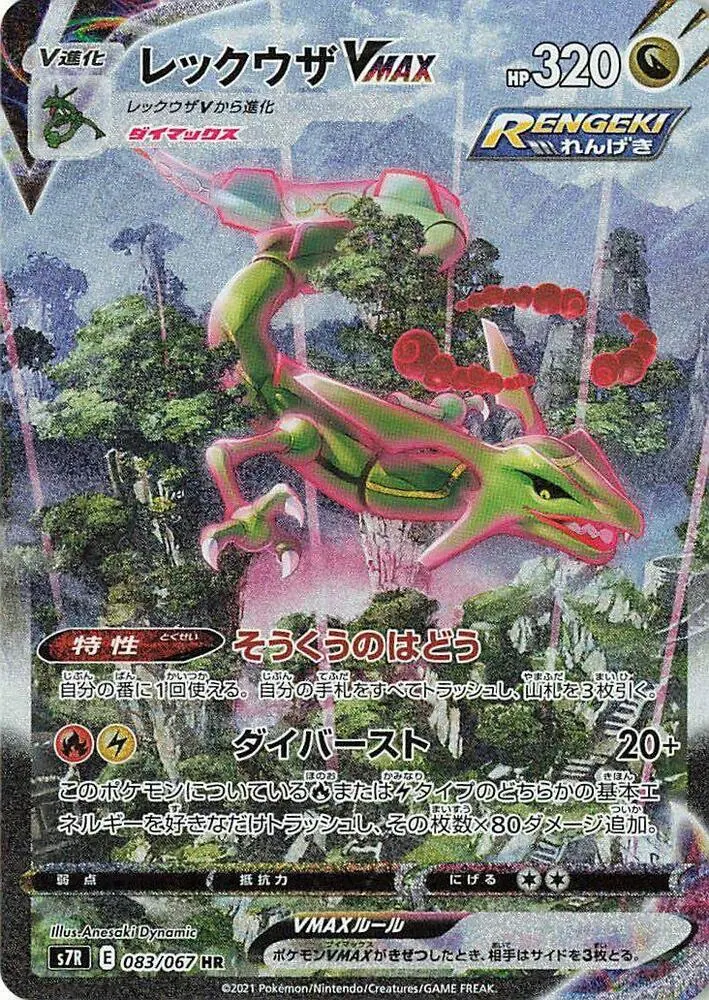
A raw Japanese Rayquaza VMAX from Blue Sky Stream sells for about $2,875 today, roughly $634 more than it cost at the end of July. The PSA 10 of that same card went the other way over those three months, sliding from $6,762.50 to $5,503.58.
That is the ugliest pair of moves a grader can run into, because the card you have to buy first got more expensive while the slab you were trying to make got cheaper. On July 27 we ran four matched Japanese and English pairs through the grading math and told readers the Japanese Rayquaza was the best submission of the group. Ninety days is almost exactly one trip through PSA's Priority queue, so we pulled the same PriceCharting grade grids again this morning to see what somebody who agreed with us would be holding.
Four cards, July 27 against October 26
| Card | Raw then / now | PSA 10 then / now | PSA 10 vs raw, then / now |
|---|---|---|---|
| Charizard ex, English Obsidian Flames #223 | $115.90 / $89.41 | $790.00 / $657.39 | 6.8x / 7.4x |
| Charizard ex, Japanese Ruler of the Black Flame #134 | $160.38 / $152.74 | $467.69 / $390.87 | 2.9x / 2.6x |
| Rayquaza VMAX, English Evolving Skies #218 | $1,033.58 / $1,030.98 | $2,851.30 / $1,910.28 | 2.8x / 1.9x |
| Rayquaza VMAX, Japanese Blue Sky Stream #83 | $2,241.00 / $2,875.00 | $6,762.50 / $5,503.58 | 3.0x / 1.9x |
Every number came off PriceCharting, once on July 27 and once on October 26, so this is one source scored against itself.
Three of the four got worse to grade. The only one that improved was the English Charizard ex, and it improved for an unglamorous reason: its raw price fell 23% while its PSA 10 only fell 17%, so the card is cheaper to buy and the slab held up slightly better.
The English Rayquaza is the strangest line in the table. Its raw price did essentially nothing over three months, going from $1,033.58 to $1,030.98, and if you had been watching only that number you would have assumed the card was asleep. The PSA 10 fell 33% in the same stretch. In July a PSA 10 of that card was worth a little under three times a raw copy, and today it is worth about twice.
Why a Japanese PSA 10 can fall while the raw card climbs
The Japanese Rayquaza answer is sitting in the population report. PSA has graded 3,001 copies of Blue Sky Stream #83, and 2,542 of them came back a 10, which works out to a gem rate of about 84.7%. Another 36 were added in the most recent month. Those figures come from our mirror of the PSA population data, last refreshed on October 1.
A gem rate that high is the thing everybody quotes as the reason to grade Japanese cards, and it is the reason the slab keeps getting cheaper. When roughly six of every seven submissions come back a 10, grading just moves your copy out of a shrinking pile of raw cards and into a growing pile of PSA 10s. Raw Blue Sky Stream copies really are getting harder to find, since the set came out in 2021 and every card that gets slabbed leaves the raw market for good, and that is exactly why the raw price climbed $634. The slabbed side has the opposite problem, with 2,542 PSA 10s already sitting out there and more arriving every month.
English cards from that era behave differently because they are much harder to gem. Evolving Skies gems at 58.9% across the whole set, and Obsidian Flames is far worse at 24.8%, so an English PSA 10 stays genuinely scarce even after years of submissions. That scarcity is what keeps the English Charizard ex trading at better than seven times its raw price while the Japanese version sits at two and a half.
The video below is a collector grading an entire Japan buying trip and walking through the returns card by card, which is a useful look at how lopsided the grade distribution gets on Japanese submissions:
Is it worth grading Japanese Pokemon cards right now?
Here is the same question we asked in July, rerun on this morning's prices and PSA's current fees. The break-even gem rate is the share of submissions that have to come back a 10 for the whole exercise to pay, so a break-even of 25% means one card in four needs to gem. Selling costs are figured at about 13.25%, and the service level is picked off what each card is worth in a 10.
| Card | Raw today | PSA 10 today | Service level | Break-even, July | Break-even today |
|---|---|---|---|---|---|
| Charizard ex, English Obsidian Flames #223 | $89.41 | $657.39 | Priority, $79.99 | about 15% | about 13% |
| Charizard ex, Japanese Ruler of the Black Flame #134 | $152.74 | $390.87 | Priority, $79.99 | about 39% | about 50% |
| Rayquaza VMAX, English Evolving Skies #218 | $1,030.98 | $1,910.28 | Express, $199.00 | about 23% | about 43% |
| Rayquaza VMAX, Japanese Blue Sky Stream #83 | $2,875.00 | $5,503.58 | Premier, $599.00 | about 12% | about 47% |
PSA's fees come straight off its pricing page this morning: Standard $59.99 with a $1,000 ceiling, Priority $79.99 up to $1,500, Express $199.00 up to $2,500, Super Express $349.00 up to $5,000 and Premier $599.00 up to $10,000, with all four Value services still paused. We covered what changed when PSA renamed and repriced those tiers in September.
The English Rayquaza actually got a $150 discount out of all this, because its PSA 10 value dropped under the $2,500 ceiling and the card no longer needs Super Express. Its break-even still went from roughly 23% to roughly 43%, which tells you how far the slab fell.
Our July call on the Japanese Rayquaza was right in the narrow sense that it stayed the better of the two, and at an 84.7% gem rate it still clears its break-even comfortably, but the money shrank hard. In July a gem on that card paid roughly $2,500 over what you spent to make it, and today the same gem pays about $923. That is a 63% cut in three months on a card we were happy to recommend, and the raw price gave no warning of it at all.
The Japanese Charizard ex is the one we would now leave alone. A break-even near 50% on a card whose PSA 10 has fallen 16% since July leaves very little room, and you would be spending $153 and a few months in PSA's queue to find out which side it lands on.
The other four calls we closed this week
Four shorter calls also came due, and all four landed on the correct side, though two of them landed by a margin too thin to count as skill.
The Pokemon GO Mewtwo VSTAR was the clean one. On August 27 we said the attention spike had already finished and the card would read below $9.42 by today, and it reads $7.65 on TCGplayer this morning, down about 19%. The Prize Pack Psyduck went further, after we called that spike over on September 10 with the card at $23.32 and the cheapest copy at $21.00. Today the market price is $15.36 and the cheapest copy is $10.45.
The other two barely got there. We said the Obsidian Flames Charizard ex would read below $5.93 today and it reads $5.87, a margin of six cents after sixty days. We said the ten 30th Celebration mini tins would not fall more than 10% from their $27.38 median, and walking all ten listing boards this morning puts the median cheapest sealed copy at $24.98, down 8.8%. Both go in the ledger as correct. Neither is worth much as evidence, because a six cent gap after sixty days sits inside the normal daily wobble of a TCGplayer market price.
What to check before you mail a Japanese card to PSA
Look up the card's gem rate first, then read it as a warning rather than an invitation. A card gemming above 80% is telling you that PSA 10s of it are easy to make and that the slab price has to carry a crowd. Pair that with how many copies are already graded, because 3,001 slabbed Rayquaza VMAX cards is a deep enough supply that your copy changes nothing about it.
Then price the PSA 10 at what it is likely to be worth when the card comes back rather than what it sells for today. On this sample of four, over one PSA cycle, the PSA 10 fell on all four cards while the raw price fell on three and rose on one. Knocking 15 to 20% off today's PSA 10 price before you decide is the same habit we landed on when PSA 10 prices were falling faster than raw cards back in August, and three months of fresh data has not given us a reason to drop it.
If you want the quick version, run the raw price, the PSA 10 price and the fee for your service level through Flipr's profit calculator and look at the break-even number rather than the headline gap. On the Japanese Charizard ex that gap still looks like $238 of free money, and the break-even says you need a coin flip to collect it.
Want to flip smarter, not harder?
Flipr's free toolkit surfaces the most profitable cards to grade and the spreads to arbitrage, refreshed every 30 minutes. Twelve tools, zero subscriptions.
Open FliprMore on PSA flipping
Grading Cheap Pokemon Cards Loses Money on the PSA 9
We ran live price grids and PSA population numbers on eight Pokemon cards on October 19. Both cards under $15 raw lost money, and the PSA 9 is why.
Only 34% of English Pokemon Cards Get a PSA 10
We read the PSA population report on September 21. Across 20.5 million graded English Pokemon cards, 34.2% came back a 10, and the rate swings hard by set.
CGC 10 Pokemon Cards Sell for About Half a PSA 10
We read every recorded eBay sale of six graded Pokemon chase cards. A CGC Gem Mint 10 sold 23 to 55% under the PSA 10 of the same card, every time.