
30th Celebration Mew ex Dropped to $157.94 on Launch Day, and Alolan Vulpix V Doubled
The Futuristic Rare Mew ex was asking $1,808.25 on presale and traded at $157.94 a day after 30th Celebration launched. Alolan Vulpix V rose 92% in a month.
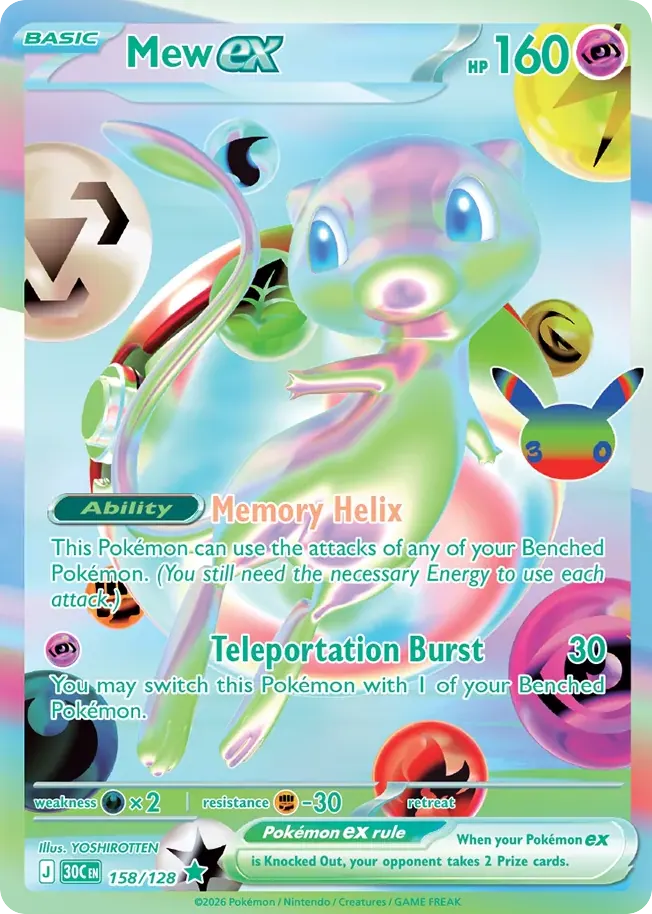
Pokemon TCG: 30th Celebration went on sale worldwide on September 16, and the first day of real trading was rough on the set's headline card. The Futuristic Rare Mew ex sat on TCGplayer presale boards at $1,808.25 the morning it launched. A day later, with packs actually opened and copies in hand, it was trading at $157.94. Mew was also the most talked about Pokemon on the card subreddits this week by a wide margin. The week's biggest genuine price gain belongs to a stamped promo that nobody is discussing at all.
What's hot: Mew ex (30th Celebration #158)
The card is Mew ex, 158/128, the Futuristic Rare from Pokemon TCG: 30th Celebration, illustrated by YOSHIROTTEN. Futuristic Rare is a brand new rarity introduced with this set, and YOSHIROTTEN is a graphic designer rather than a regular Pokemon card illustrator, so the finish looks like nothing else in the hobby. That combination is most of why the card became the week's story.
The attention is measurable. Across our sweep of the card subreddits, Mew picked up 44 mentions on launch day against a trailing average of 14 over the previous two weeks, roughly three times its normal volume and the highest count of any Pokemon we track. The set itself went from about four mentions a day through early September to 18 on the 16th.
What happened to the price is the part worth saving. Presale asks on the Futuristic Rare Mew ex ran $3,166.50 on September 2, climbed to $3,333 from the 5th through the 10th, eased to $1,977.66 on the 14th, and were still $1,808.25 on the 15th and 16th. Those were asks on a board with no completed sales behind them, which is the thing to remember about any presale number. Once the set was actually out and copies started changing hands, the market price on September 17 read $157.94, with the cheapest listing at $156 and the middle of the board at $388. The Futuristic Rare Mewtwo ex, #157, followed the same path from $829.99 on release day down to $102.26.
Two other readings from launch day are worth having. The Special Illustration Rare Mew ex, #152 by Kuroimori, is trading at $231.14, comfortably above the Futuristic Rare that everyone was chasing. And the three RGB Mew cards, the R, G and B promos also drawn by YOSHIROTTEN, have no market price at all because nothing has sold; the only numbers on those boards are asks between $6,789.99 and $9,000. A card with asks and no sales is a card without a price yet.
For anyone holding one, the honest read is that the supply wave has barely started. One day of opened product is nothing, and every new set we have tracked through its first weeks has kept sliding while people bulk open boxes, which is the whole argument in our piece on what actually happens when new set chase cards drop. Grading does not rescue the timing either, because PSA's queue runs months and there is no graded comp for a card that came out yesterday. If you pulled one, sitting on it through the opening wave costs you nothing. If you are buying, there is no reason to be first.
Our call: the Futuristic Rare Mew ex is cheaper than $157.94 when we check back on November 1. We are not naming a floor, because we have been wrong doing that three separate times, and an attention move decays toward its fundamentals rather than stopping at a level someone picked. The counter-argument, stated plainly: a brand new rarity with a designer name attached has no comparable card in the hobby, and if collectors decide the Futuristic Rare finish is a genuinely new collectible category rather than a set gimmick, day one may turn out to have been the bottom rather than the top. We will grade this right or wrong in a future post.
Biggest gainer: Alolan Vulpix V (Play! Pokemon Prize Pack Series Three #033/195)
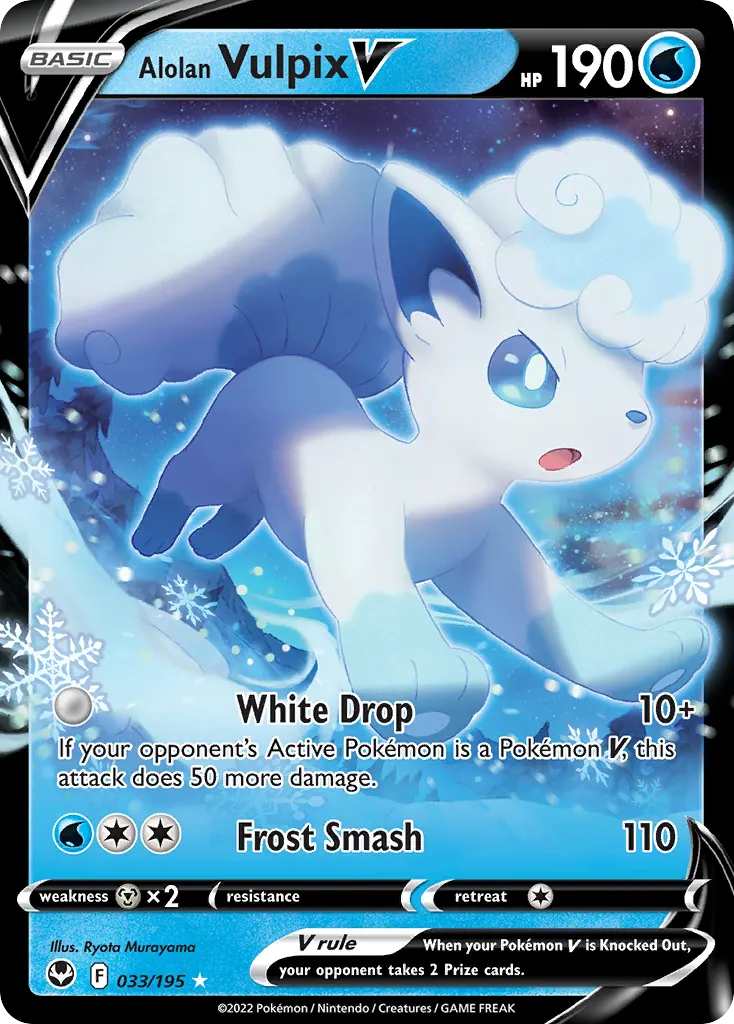
The card above is the Silver Tempest printing of Alolan Vulpix V, 033/195, illustrated by Ryota Murayama. The copy that moved is the Play! Pokemon Prize Pack Series Three version, which is the same artwork carrying a gold Play! Pokemon stamp on the front. The stamp is the entire difference, and it is also nearly the entire price.
The move is small in dollars and large in percentage. TCGplayer's market price on the stamped printing read $10.85 on August 18, $17.67 on September 10, and $20.91 on September 17, which is about 18% on the week and roughly 93% on the month. What makes it worth writing up rather than dismissing is the shape. Across twelve consecutive readings since the end of August the number went 15.09, 15.64, 16.26, 16.26, 16.97, 17.67, 17.67, 17.67, 18.54, 18.54, 20.73, 20.91. That is a steady climb, not the one day jump that usually turns out to be a single odd sale on a thin board.
The board is real too, which is not something we could say about most of this week's percentage leaders. Checking the live listings, the stamped printing has 20 listings covering 16 near mint English copies, and the cheapest one you can actually get delivered is $30.91. PriceCharting has the same card at $41.38 ungraded. So there are three numbers in play, $20.91, $30.91 and $41.38, and they disagree in a specific direction: the TCGplayer aggregate is the lowest of the three and it has been climbing toward the other two all month. Nobody is printing Prize Pack Series Three any more, so no new copies are entering, and on a card with fixed supply and infrequent sales the aggregate is usually the number that lags.
We could not find a catalyst, and we looked. There is no reprint news, no tournament result, and no thread driving it. Take that at face value rather than as a hint: sometimes a small fixed pile of a popular Pokemon gets quietly bought up and the only visible evidence is the price. If you want the comparison, the ordinary Silver Tempest printing of the same card sits at $2.52 ungraded, so buyers are paying somewhere between twelve and sixteen times the price of the identical artwork to get the stamp.
For flippers, the sell raw case is strong and the grading case barely exists. There is no graded price grid for the stamped printing at all, which means if you send one in you are guessing at your exit. The base Silver Tempest printing does have one, and its PSA 10 is $63.75, which will not cover a submission on a card you bought at $31 once you account for the fee and the selling cut. The cheapest route PSA currently offers runs $59.99 and takes 90 to 100 business days, and we walked through where that math does and does not work in our piece on PSA Standard versus Priority. This is a raw card.
Our call: the TCGplayer market price on the stamped printing is higher than $20.91 on November 1, closing toward the $30.91 you have to pay to actually receive one. This applies a lesson we earned the hard way, that a price gap closes toward whichever side is stale, and staleness depends on whether anyone is still opening product that contains the card. Nobody is, here. Wrong if the market price is flat or lower.
Scoring last month: we got the Unfair Stamp call backwards
On August 15 we wrote that the Prize Pack Series Six printing of Unfair Stamp would be cheaper a month later, on the theory that the reason to own a Standard staple runs out when the competitive season closes on August 31. That was wrong, and it was wrong in both directions we said to measure.
The cheapest near mint English copy delivered went from $67.99 to $71.48. The TCGplayer market price went from $58.96 to $61.20. The board still holds 14 copies, the same as when we wrote it, which is exactly the counter-argument we put in the original post and then talked ourselves out of. The detail that should have stopped us is that the plain Twilight Masquerade printing of Unfair Stamp rose too, from $10.00 to $11.94 on PriceCharting over the same window. When both printings of a card move together, the story is demand for the card, and the promo premium is just a multiplier sitting on top of it. We were testing the promo's scarcity when the thing actually setting the price was interest in the card. The rule we are keeping: before calling a staple lower because of a date on the calendar, check whether the ordinary set printing agrees, and if it does not, the calendar is not what is pricing the card.
What this week is telling you
The two halves of this post are the same lesson pointed in opposite directions. Presale asks on the Mew ex were a number nobody had paid, and they fell 91% the moment real sales existed to measure against. The Alolan Vulpix V market price is a number built entirely from real sales, and it has been quietly climbing toward what sellers are actually charging. Asks without sales run ahead of the truth, and aggregates on thin fixed supply run behind it.
The concrete thing to do this week: if you are looking at 30th Celebration, wait. The set is one day old, the Classic Collection reprints that everyone argued about are already repricing (the Gengar Prime reprint we flagged in last week's post opened at $95.66 against asks near $1,000 the week before), and nothing about buying in the first fortnight of a set has ever paid off in the year we have been tracking it. Check back when the boxes stop being opened.
Want to flip smarter, not harder?
Flipr's free toolkit surfaces the most profitable cards to grade and the spreads to arbitrage, refreshed every 30 minutes. Twelve tools, zero subscriptions.
Open FliprMore on PSA flipping
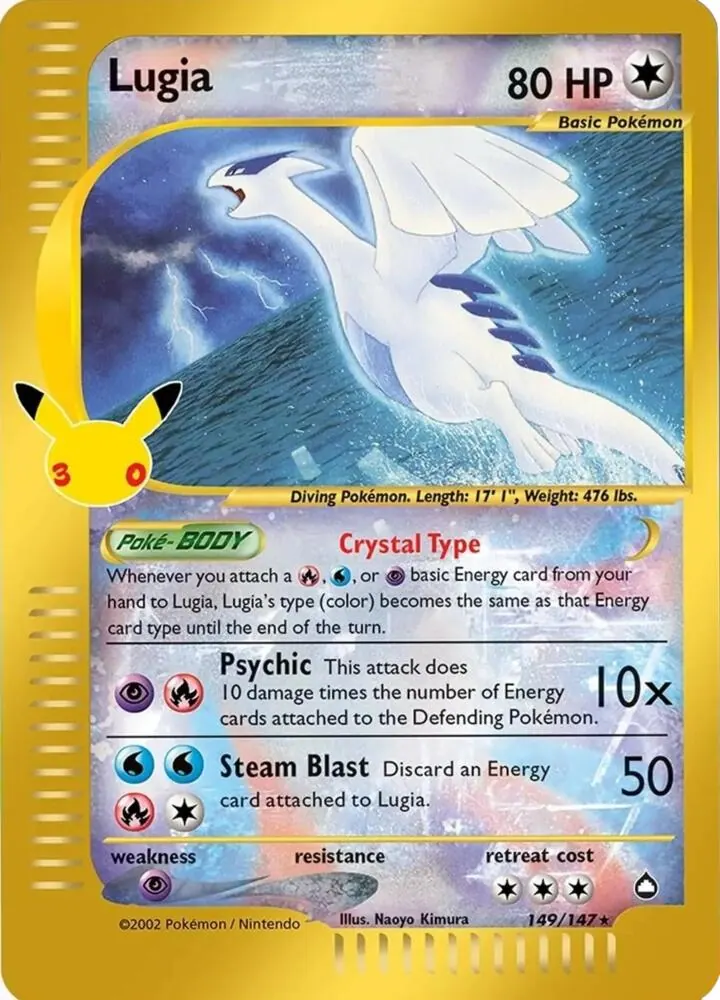
Crystal Lugia Reprint Price Opened at $251, and Fezandipiti ex Jumped 32% in a Week
The 30th Celebration Crystal Lugia asked $1,300 in presale and sells for $251. Fezandipiti ex rose 32% in both of its printings. Here is what we would do.
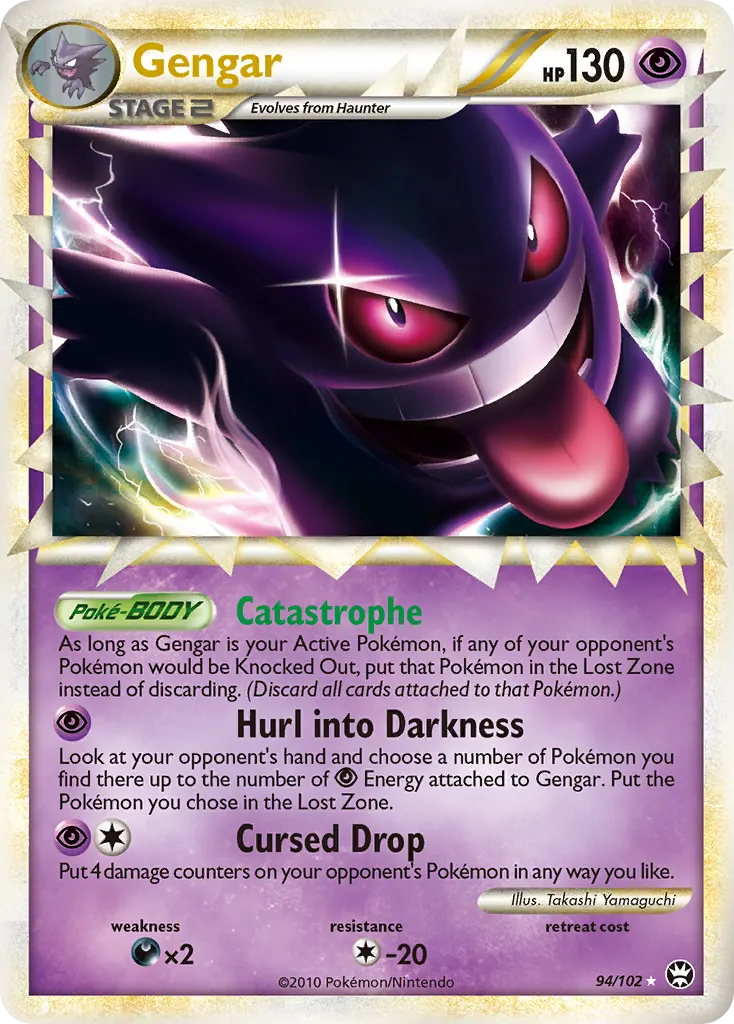
Gengar Prime Is in the 30th Celebration Classic Collection, and Prize Pack Psyduck Jumped 52% in a Week
Gengar Prime, HS Triumphant 94, is a confirmed 30th Celebration reprint with a $16,563 PSA 10, and the Prize Pack Psyduck 039/217 rose 52% in a week.
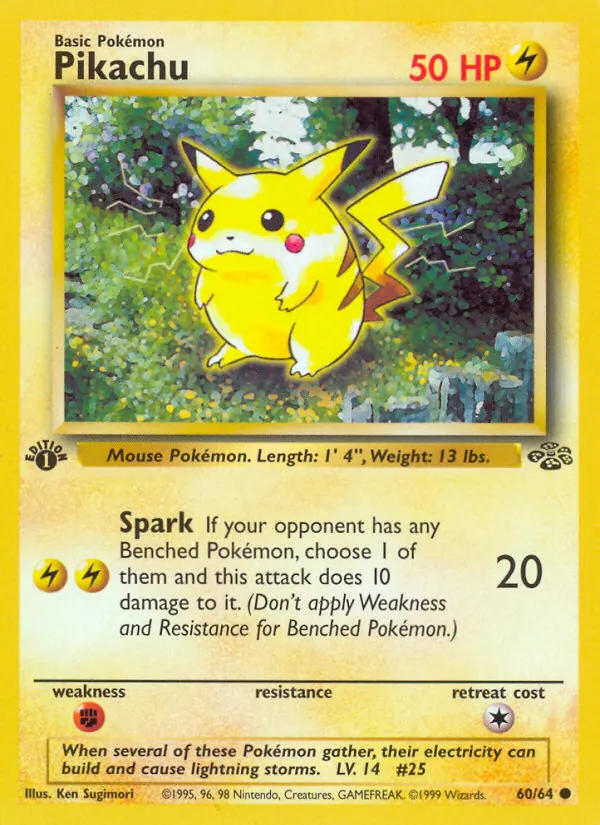
Sugimori's New 30th Celebration Pikachu Has Collectors Checking Jungle Pikachu Prices, and Prize Pack Charizard VMAX Jumped 81%
Ken Sugimori's 30th Celebration Pikachu recreates his Jungle #60 art, a card worth about $22 raw with a $1,262 PSA 10. A Prize Pack Charizard VMAX also jumped 81% with exactly one copy for sale.